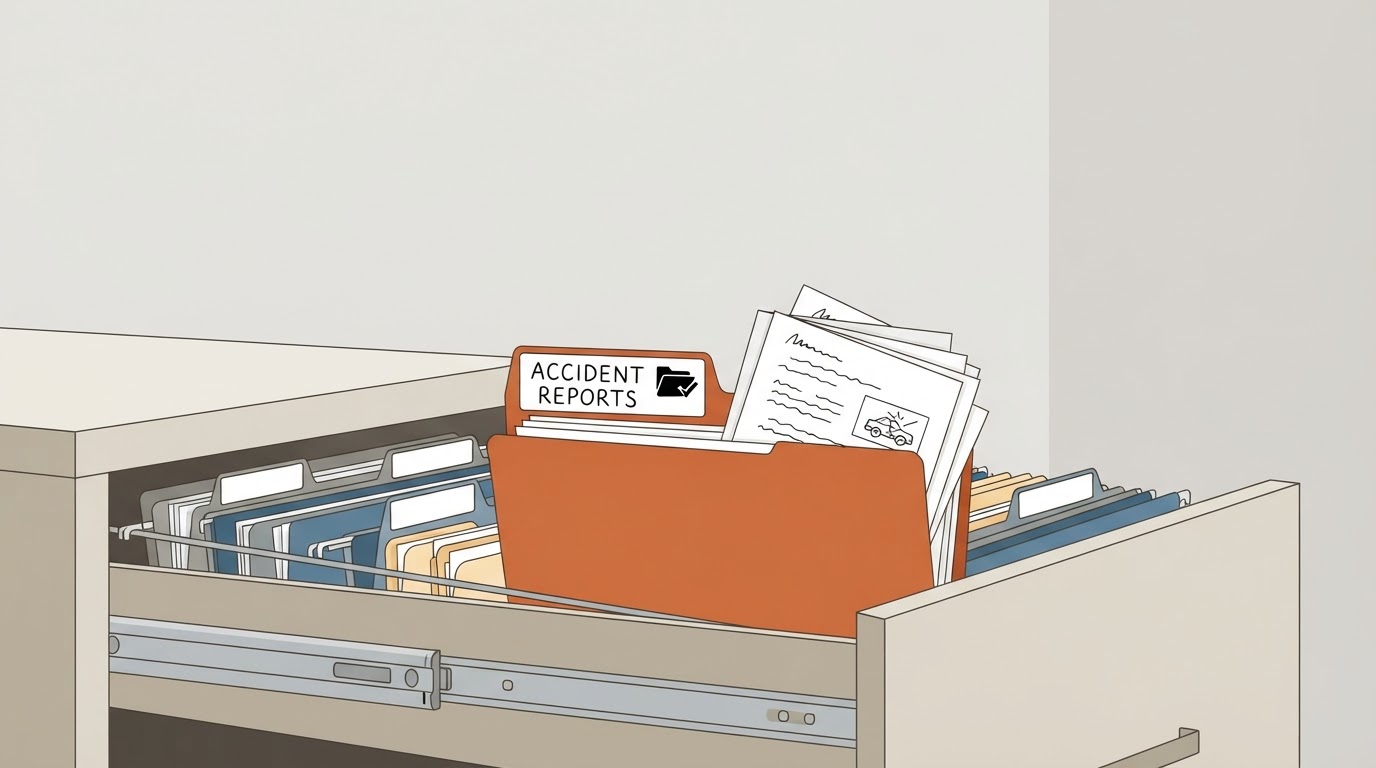
Once a claim closes, it’s tempting to shred everything and move on. Resist that urge for a while longer. The paperwork from a car accident claim isn’t just proof of what happened – it’s your backup if a question comes up months later, whether that’s from your insurer, the other driver’s insurer, a repair shop, or your own record-keeping when it’s time to renew your policy. This guide covers what’s worth keeping, and for how long, so you’re not stuck digging through old email threads under pressure.
Photos and the Police Report
Photos taken at the scene are some of the most valuable records you’ll ever have from a claim, and they’re also the easiest to lose. Phones get replaced, cloud storage gets reorganized, and suddenly the pictures from the day of the accident are gone. Before you do anything else, move your accident photos off your phone and into at least one other location – a cloud backup folder, an external drive, or an email you send to yourself with the images attached.
Keep every photo, even the blurry ones or the ones that seem redundant. A picture of the same dent from four angles might not matter, but a wide shot showing the road, the weather, or the position of the vehicles can matter a lot if there’s ever a dispute about how the accident happened. Also hold onto photos of:
- All vehicles involved, including angles that show the full extent of the damage and any that show no damage at all
- License plates, VINs if visible, and insurance cards or declarations pages exchanged at the scene
- Road conditions, skid marks, debris, traffic signals, and any relevant street signs
- The surrounding area, including cross streets or landmarks that establish exactly where the accident happened
If you filed a police report, get a copy as soon as it’s available – most departments have a process for this, often through a records division or an online portal, and there’s usually a small fee. Read it over when you get it. Police reports sometimes contain errors: a misspelled name, a wrong vehicle color, a transposed digit in a plate number. If you spot a mistake, most departments have a process for submitting a correction request. It’s worth doing sooner rather than later, since these reports often end up feeding directly into how your insurer and the other driver’s insurer log the incident.
Keep both the photos and the police report in the same place, ideally with a copy of the claim number written somewhere on or near the file. That single number is often the thread that ties every other document back together.
Correspondence with the Adjuster
Every phone call, email, letter, and text with your claims adjuster is worth saving. Adjusters manage a lot of files at once, and details can get miscommunicated or forgotten – not out of bad faith, just volume. Having a written record protects you from having to re-explain something you already covered, and it gives you something concrete to point back to if two conversations seem to contradict each other.
A few habits make this easier as you go:
- After any phone call with an adjuster, send a short follow-up email summarizing what was discussed. Something like “Confirming our call today – you mentioned the estimate would be ready by [date] and that a rental is approved through [date].” This creates a written record even for conversations that happened verbally.
- Save every email in a dedicated folder rather than letting it sit in your general inbox. Label it with the claim number so it’s searchable later.
- If you receive anything by mail – a letter, a check, a settlement offer – scan or photograph it before filing the paper copy away, in case the original gets lost.
- Note the date, time, and the adjuster’s name after every call, even the quick ones. If your claim changes hands to a different adjuster at some point, this history helps the new person get up to speed and helps you keep track of who said what.
This record-keeping isn’t about building a case against anyone. Most claims proceed without any conflict at all. But claims can take weeks or months to fully resolve, especially if there’s a second vehicle, injury evaluation, or a total loss determination involved. Having a clear paper trail simply keeps everyone – including you – working from the same set of facts.
Repair Invoices and Estimates
If your vehicle needed repairs, you likely received more than one document along the way: an initial damage estimate, possibly a revised estimate once the shop got into the vehicle and found additional issues, and a final invoice once the work was done. Keep all of them, not just the final one.
The estimates matter because they show what was expected to be fixed and roughly what it was expected to cost. The final invoice matters because it shows what actually happened – which parts were used, whether they were new, used, or aftermarket, what labor was performed, and what the shop actually charged. If a repair issue crops up later – a rattle that wasn’t there before, a paint mismatch, a part that fails – these documents help establish what was done and when.
Also keep:
- Any supplemental estimates or change orders, which show why a repair cost more or took longer than originally planned
- The shop’s warranty information for the repair work, if one was provided
- Rental car agreements and receipts, if a rental was part of your claim
- Receipts for any out-of-pocket costs you paid that were later reimbursed, along with proof of that reimbursement
- If your vehicle was declared a total loss, the paperwork showing the vehicle’s valuation and the settlement offer, along with any title transfer documents
These records are useful beyond the claim itself. If you sell the car later, being able to show a clean, well-documented repair history can matter to a buyer. And if you ever need to reference the accident for insurance purposes down the line – say, a future insurer asks about your claims history – having the invoice on hand means you’re not relying on memory.
How Long to Keep Everything
There’s no single universal rule for how long to hold onto claim records, because it depends on the type of document and what it might be needed for later. As a general approach, though, a few guidelines work well for most drivers:
- Photos and the police report: Keep indefinitely, or at minimum for several years after the claim closes. These are the foundation documents for the entire incident, and they’re the hardest to reconstruct if you need them later and don’t have them. Digital storage is cheap – there’s little reason to delete these.
- Adjuster correspondence: Keep for at least a few years after the claim is fully settled. Some issues – a repair problem, a billing question, a dispute over a bill from a medical provider or another driver – can surface well after a claim appears closed. If you can, keep this correspondence as long as you keep the photos and police report, since it often references them directly.
- Repair invoices and estimates: Keep for as long as you own the vehicle, and ideally a bit beyond that. These documents support any future claim, warranty question, or resale conversation involving the car.
- Claim settlement letters and final payout documentation: Keep indefinitely if the settlement was significant, such as a total loss payout. These are the kind of records you may want years later for tax purposes, loan payoff questions, or simply peace of mind.
- Everyday receipts tied to the claim (rental cars, towing, minor out-of-pocket costs): Keep for at least a year after reimbursement is confirmed, in case a reimbursement is questioned or a payment doesn’t process the way you expect.
A simple system beats a perfect one. A single folder – physical or digital – labeled with the claim number and the date of the incident is usually enough. If you’re keeping paper copies, a manila folder in a drawer works fine. If you’re going digital, a dedicated folder in your cloud storage, backed up in more than one place, is worth the ten minutes it takes to set up. Whatever you choose, the goal is the same: when a question comes up six months or two years from now, you can find the answer in under five minutes instead of trying to remember which email account you used or which drawer you filed things in.
One last habit worth building, even outside of an active claim: start a general folder now for insurance documents – your policy, your declarations page, your ID cards – so that if you’re ever in an accident, you’re not starting from zero. Being prepared before something happens is a much calmer position than trying to get organized while you’re also dealing with a damaged car and a stressful day.