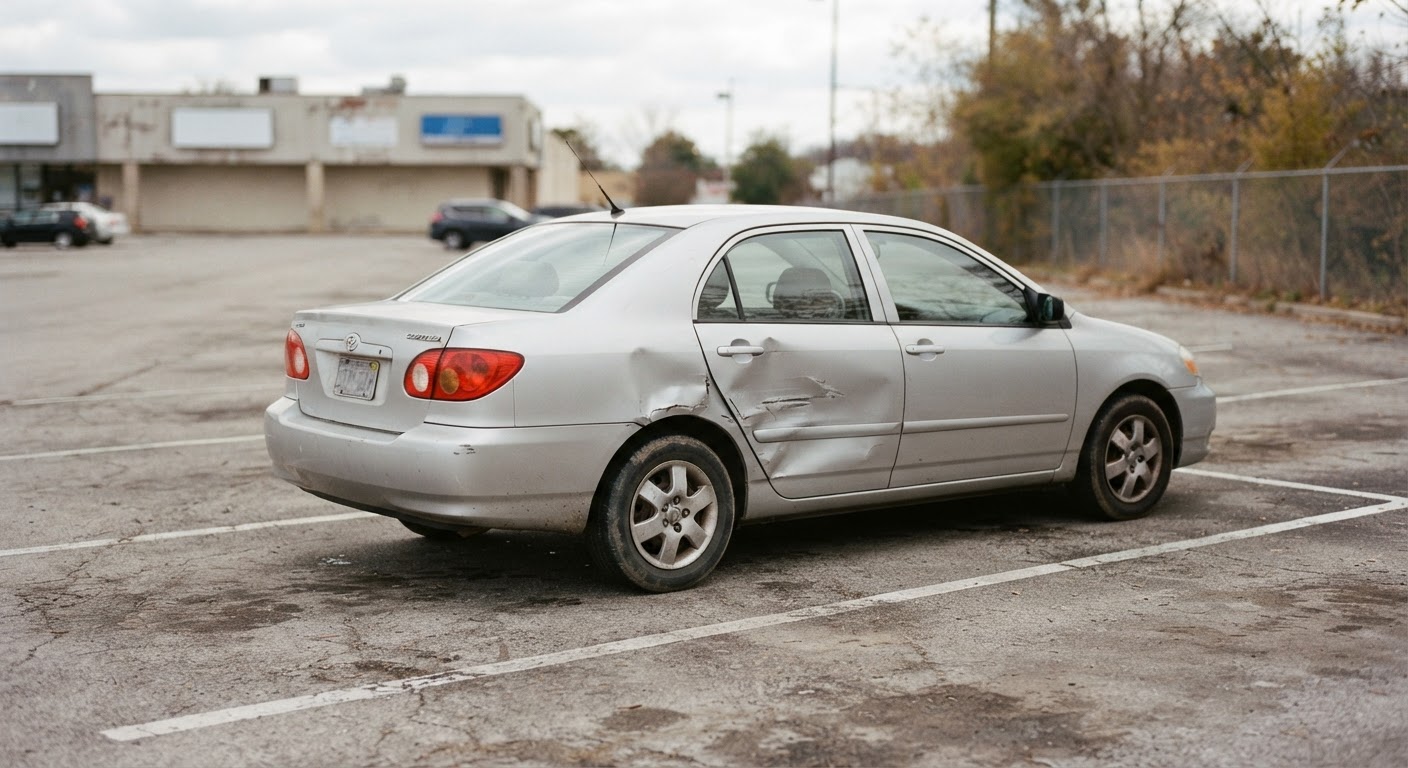
You come back to your car and there’s a dent, a scrape, a shattered taillight — and no note, no driver, no explanation. Someone hit your car and left. It’s frustrating, and it can feel like there’s nothing to do about it. That’s not quite true. What you do in the next twenty minutes, and the next few hours, has a real effect on whether this ends with your car fixed or with you covering the cost yourself.
Take a breath first. Then work through this in order.
Check the area for the vehicle or driver
Before you do anything else, look around. Hit-and-run drivers in parking lots often haven’t gone far. They might be circling for another space, sitting in their car deciding what to do, or walking into the same store you were headed toward.
- Scan nearby rows for a vehicle with fresh damage that matches the height and location of the damage on your car — a scraped bumper, a cracked headlight, a smear of paint that doesn’t belong.
- Look for anyone standing near their car looking uneasy, or anyone walking away quickly.
- If you spot a vehicle that looks like a match, do not confront the driver. Note the location, the make and model, the color, and the license plate if you can see it. Confrontation in a parking lot over property damage isn’t worth the risk to your safety.
If you genuinely believe you’ve identified the vehicle or driver, that information goes to the police when you report this, not into a conversation you have yourself in the parking lot.
If there’s no one around and nothing looks out of place, that’s fine too. Most hit-and-run cases in parking lots are solved, if they’re solved at all, through cameras and paperwork, not through spotting the culprit on the spot.
Look for witnesses and cameras
This is the step people skip because they’re rattled and just want to get home. Don’t skip it. Evidence in a parking lot disappears fast — people drive off, and footage gets overwritten on a loop within days at a lot of businesses.
Witnesses
Look for anyone nearby: someone loading groceries a few spaces over, an employee on a smoke break, a person walking to their car. Ask directly: “Did you happen to see what hit my car?” Most people will tell you plainly if they saw something or didn’t.
If someone did see it, get their name and phone number on the spot. Don’t rely on them offering — ask. People mean well but forget, or leave before you think to circle back. A name and number written in your phone, even misspelled, is far better than nothing.
Cameras
Look up. Parking lots attached to stores, malls, apartment complexes, and office buildings often have security cameras covering at least part of the lot. You’re not trying to identify the footage yourself — you’re trying to flag it before it’s gone.
- If you’re at a business, go inside and ask for a manager. Explain what happened and ask whether their parking lot cameras cover the area where your car was parked.
- Ask them to preserve the footage from the relevant time window, even if they can’t hand it over to you directly. Footage often needs to go through police request rather than being given straight to a customer, but a manager who’s aware there’s a request coming is far more likely to save it before it’s automatically deleted.
- If you’re in a residential or apartment lot, note the property management company’s contact information from a sign or your own paperwork, since it may take a call rather than an in-person visit.
Do this before you leave the lot, not from home later. Once you drive off, you often lose the ability to point precisely at “that pole, that angle, this exact time” — and that specificity is what makes footage useful.
Document everything before you leave
Once you’ve checked around and asked around, slow down and document. This is the part that protects you regardless of whether the driver is ever found.
- Photograph the damage from multiple angles. Wide shots showing where the car is parked, medium shots showing the damaged panel, and close-ups of the dent, scrape, or broken part. Include a photo with something for scale, like a coin or your keys, if the damage is small.
- Photograph the surroundings. Get the parking space number or location, nearby landmarks, and anything relevant like debris on the ground (a broken piece of trim or plastic from the other vehicle can sometimes help identify make and model later).
- Photograph any physical evidence left behind. Paint transfer, plastic fragments, tire marks. If a piece of the other car’s bumper or trim is sitting on the ground, photograph it in place before you touch it, then consider whether to leave it for police documentation.
- Note the time. When did you park, and roughly when did you return to find the damage? This narrows the window investigators or camera reviewers need to look at.
- Note the weather and lighting. It sounds minor, but it matters if footage needs interpreting later.
- Write down what you did and who you talked to — the manager’s name, the witness’s name and number, which direction you saw a suspicious vehicle head, if any. Do this while it’s fresh. Memory of small details fades within hours, not days.
None of this needs to be fancy. Your phone’s camera and a note in your phone are enough. The goal is to have a clear, time-stamped record before anything gets cleaned up, moved, or forgotten.
Report it the same day
Two reports need to happen, and both are best done the same day while details are fresh and evidence still exists.
Report to police
File a police report even though it’s “just” a dented door and even though you know the odds of catching the driver are long. There are practical reasons to do this regardless of outcome:
- Many insurance companies expect or require a police report for a hit-and-run claim, particularly if you’re seeking coverage for damage caused by an unidentified driver.
- A report creates an official time-stamped record of the incident, which matters if there’s ever a dispute about when or how the damage happened.
- If cameras or witnesses do turn up something usable, having a report already on file means there’s somewhere for that information to go.
Depending on where you are and how the local department handles property-damage-only incidents, you may be able to file online or by phone rather than needing an officer to come to the lot. Ask what their preferred process is. Get the report number and the responding officer’s name or badge number if one is assigned, since you’ll likely need to reference the report when you file your insurance claim.
Report to your insurance company
Call your insurer the same day, or as soon as reasonably possible afterward. Reporting promptly matters for a few reasons:
- Most policies expect timely reporting, and delay can complicate how a claim is handled.
- The details are freshest right after the incident — exact timing, what you observed, who you spoke to.
- If there’s coverage available for damage caused by an unidentified driver, your insurer can tell you what they need from you and what the next steps look like, including whether they need the police report number, photos, or a copy of any camera footage that gets located later.
Whether this kind of damage is covered, and under what part of your policy, depends on the coverage you carry and the details of your specific policy. Ask your insurer directly rather than guessing, since coverage for hit-and-run and unidentified-driver damage varies by policy and by state, and your agent or claims representative can tell you exactly where you stand and what documentation they’ll want.
Be plain and factual when you report it. Stick to what you observed and what you did: where you parked, what time you left the car, what you found when you returned, who you spoke to, what you photographed. You don’t need to speculate about who did it or why — just lay out the facts you gathered.
A quick checklist for next time
Once this particular situation is handled, it’s worth building a couple of habits that make the next one, if there ever is one, much less stressful:
- Keep a small notebook or a notes app shortcut in your car for jotting down details quickly.
- Know where your insurance company’s claim-reporting number or app is before you need it, not after.
- Get in the habit of glancing at your car when you return to it, rather than assuming everything’s fine — catching fresh damage immediately, versus a day later, makes documenting it far easier.
A hit-and-run in a parking lot is aggravating precisely because it feels unresolved — there’s no other driver to exchange information with, no clear next step handed to you. But the steps above are the next step. Check the area, gather witnesses and camera leads before they vanish, document thoroughly, and report it the same day. That’s what actually moves this from “dented door with no answers” to a claim that has something to work with.